
Research brief · Financial services & insurance
The AI oversight gap in financial services.
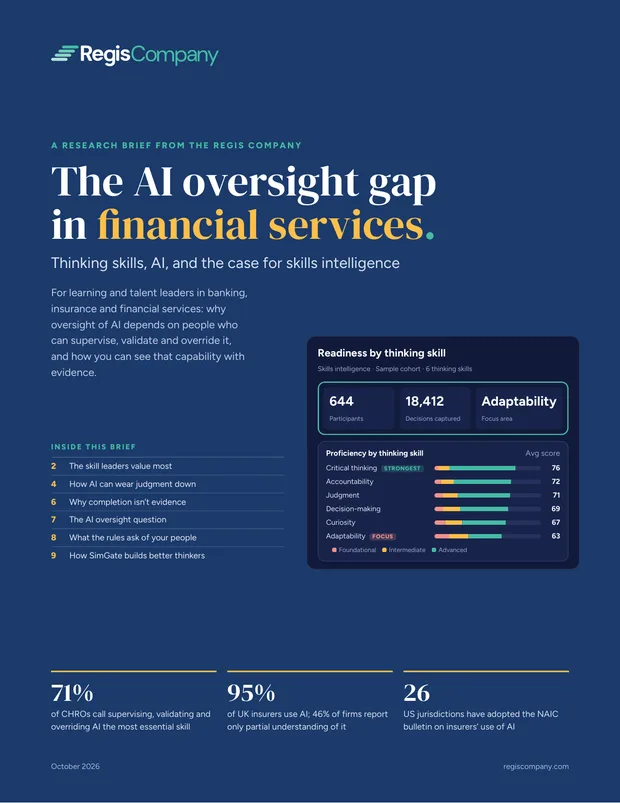
AI now informs credit, underwriting, and claims decisions. The rules that govern it call for people who are competent to challenge a model’s output, and for records an examiner can review. This brief shows what that asks of your learning strategy, and how practice produces the evidence.
Inside the brief
- What the EU AI Act, NYDFS, SR 26-2, and FINRA say about human oversight and competence
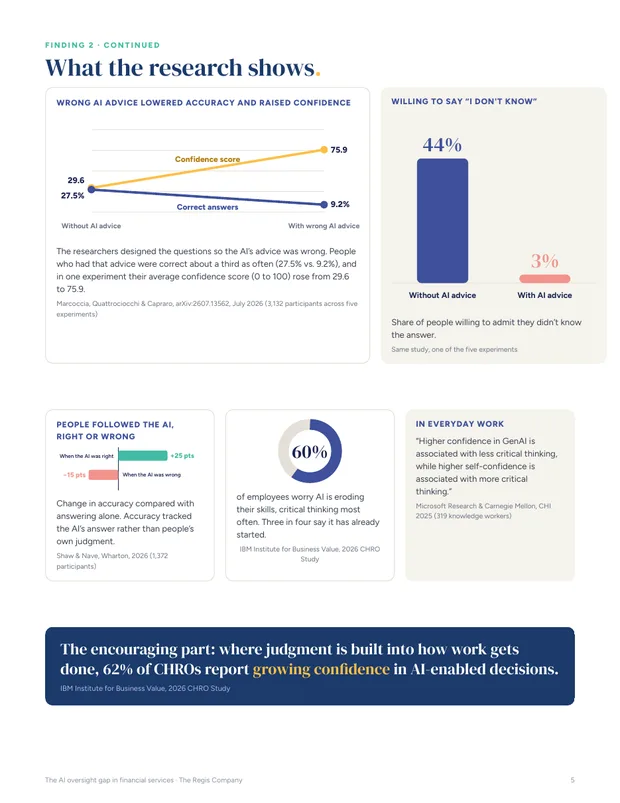
- New research on what happens to accuracy and confidence when AI advice is wrong
- Why completion records say little about competence, and what skills intelligence adds
- Why the ability to challenge an AI answer can be practiced, and how that practice produces evidence
- 71%of CHROs call supervising, validating, and overriding AI the workforce’s most essential skillIBM Institute for Business Value, 2026
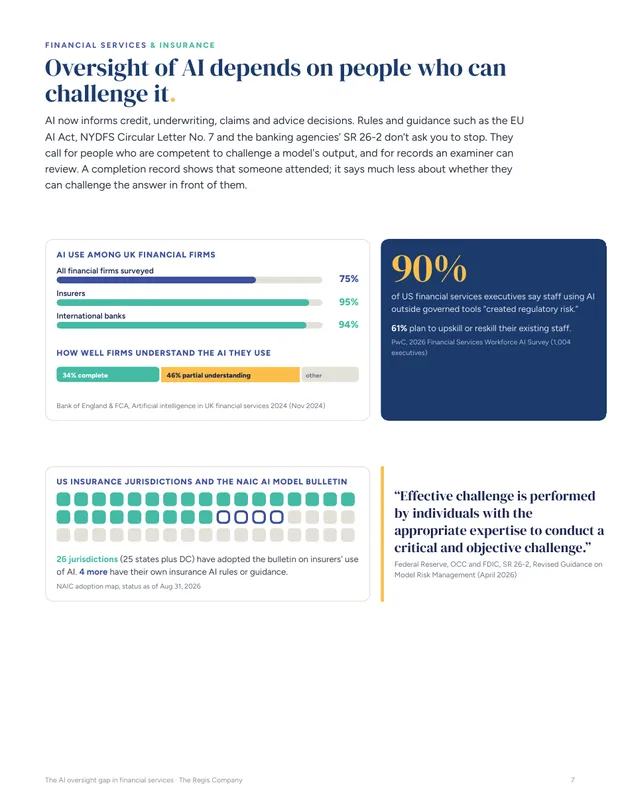
- 95%of UK insurers use AI, yet 46% of firms report only partial understanding of the AI they useBank of England & FCA, 2024
- 26US jurisdictions have adopted the NAIC bulletin on insurers’ use of AINAIC, Aug 2026
A look inside the brief.
When AI advice was wrong, people in the studies became less accurate and more confident. Read a few sample pages to see what the research found, and how practice builds the judgment your people need to catch the mistake.
Click a page to read it.
AI reduces effort, not accountability. The person who acts on the answer still owns the outcome.
50+ industry awards.
These include three Brandon Hall Group Gold awards in 2025 (Skills Intelligence, Leadership Development, and Simulation Technology) and a place on Training Industry’s Top 20 Experiential Learning Technologies list in 2025 and 2026.





Get the brief.
The research, the regulatory text, and a practical look at how your organization can see, with evidence, how its people decide when AI is in the loop.
Send me the brief